Top 5 Aluminium Sliding Window Accessories Every Fabricator Must Install
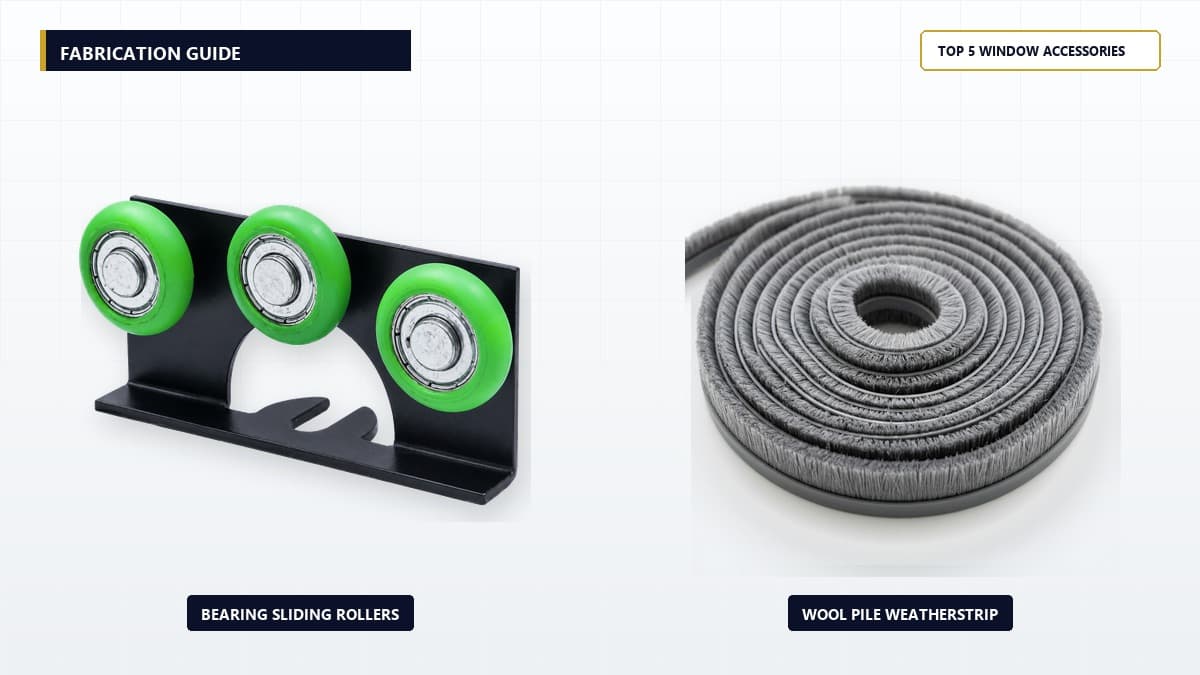
A rattle-free, dust-tight sliding window depends on the hardware inside the profile. The 5 essential accessories fabricators in Raipur and Chhattisgarh need for smooth glide and longevity.
What causes aluminium sliding windows to rattle in high wind?
Worn or missing wool pile weatherstripping and undersized sash buffer stoppers allow the shutter profile to vibrate inside the outer track frame when wind pressure strikes the glass.
Which roller is best for residential aluminium sliding windows?
Heavy-duty sealed ball bearing rollers with virgin nylon wheels (such as 625/626 bearing C-rollers or G-rollers). Sealed steel ball bearings prevent Raipur dust and grit from seizing the axle, while nylon wheels glide silently without eroding the bottom aluminium track.
Why do fabricators install anti-lift blocks on sliding windows?
Anti-lift nylon blocks sit in the top track cavity above each sash. They prevent intruders from levering the sliding shutter upward and popping it off the bottom track from outside.
What is the difference between a crescent lock and a touch lock for sliding windows?
A crescent lock uses a rotating eccentric brass or zinc cam that pulls the two meeting stiles tightly together for maximum air and acoustic seal. A touch lock is spring-loaded and snaps automatically into the frame receiver when the shutter slides shut, ideal for quick one-touch operation.
How often should window rollers and wool pile brush be replaced?
In high-dust, industrial or highway environments across Chhattisgarh, wool pile should be inspected every 3 to 5 years, and nylon rollers typically last 7 to 10 years when high-grade sealed ball bearings are specified.
The hardware inside the track determines the window
When a homeowner tests a new aluminium sliding window, they do not touch the aluminium extrusion. They touch the lock, feel the weight of the sash as it slides, and listen for metal grating or vibrations.
The aluminium section (whether standard 18mm, 2-track, 3-track, or 27mm Domal profile) provides the structural envelope. But how that window feels every single day for the next decade depends entirely on five internal accessories.
Skimping on these parts saves fifty rupees per window and guarantees rattling shutters, jammed rollers, and callbacks before the first monsoon ends. Here is what every fabricator in Raipur and Chhattisgarh should fit into every sliding window sash.
1. Heavy-duty sealed ball bearing nylon rollers
The entire dead weight of the glass shutter rests on two roller wheels running along the bottom aluminium track rail.
If you fit cheap plain bush rollers (a nylon wheel spinning directly on a metal rivet without ball bearings), dust and airborne sand enter the hub within months. Friction increases, the wheel stops rotating, and the homeowner ends up dragging a flat-spotted wheel across the track, gouging the aluminium extrusion.
Fit sealed 625 or 626 ball bearing rollers with virgin nylon or polyacetal wheels (like Salasar C-rollers or G-rollers). The sealed bearing shields the steel balls from dust, and the nylon compound dampens rolling noise while protecting the bottom track profile from abrasive wear. For heavy sashes (exceeding 35 kg per panel), always use double-tandem bearing rollers to distribute the point load.
2. Fin-seal wool pile weatherstripping
Without wool pile weatherstripping in the vertical and horizontal sash channels, an aluminium window is a musical instrument waiting for a windy evening.
A standard extrusion leaves a 2 to 3 mm clearance on either side of the track to allow free sliding. In high wind, air currents blast through this gap, causing the sash to flutter against the frame with an audible rattle.
High-density polypropylene wool pile with a centre plastic fin (fin-seal) acts as a flexible acoustic and dust barrier. The woven brush bristles cushion the shutter against the frame jambs, eliminating rattling, while the impermeable centre fin stops fine road dust, vehicular soot, and rain spray from infiltrating the room.
3. Ergonomic crescent or touch locks
Window security and acoustic isolation depend on how the meeting stiles lock together.
Crescent locks (cam locks) are the contractor favorite for standard two-track sliding windows. When the handle is turned, the eccentric curved brass or zinc cam hooks into the opposing keeper, camming the two vertical sashes tightly against each other. This tight compression squeezes the interlocking wool pile together, creating a superior draft and acoustic seal.
Touch locks (snap locks) are recessed flush into the window handle stile. When the window is slid shut, the spring-loaded latch tongue clicks into the jamb cutout automatically. For homeowners who want clean flush lines without protruding hardware handles, high-grade touch locks with stainless steel internal springs deliver seamless push-to-release convenience.
4. Anti-lift security blocks
Sliding windows have an inherent vulnerability: to install or remove a sash, you lift the shutter into the deep top track pocket until the bottom rollers clear the lower rail, then tilt it inward.
Intruders know this geometry. On a ground-floor or balcony window without security grilles, a crowbar inserted under the sash can lift and unseat the entire shutter in seconds.
Anti-lift blocks (nylon or PVC spacer blocks) are screwed into the upper track channel directly above the sash top rail after the shutter is placed. They restrict upward travel to less than 1.5 mm—enough for smooth horizontal sliding, but physically preventing anyone from lifting the sash off its bottom rollers from the exterior.
5. High-density rubber and nylon buffer stoppers
When family members or office occupants slide a heavy window sash open with force, the leading stile can slam directly into the outer frame jamb or the adjacent glass panel.
Without buffer stoppers, this repeated metal-on-metal impact chips powder-coated finishes, loosens corner cleat joints, and shocks toughened glass edges.
Fit heavy-duty rubber or nylon buffer stoppers at the top and bottom corners of the sliding sash. These stoppers absorb kinetic impact, protect the lock handle from smashing into the window reveal, and prevent fingers from getting pinched between overlapping stiles.
How to specify hardware for Raipur fabricators
The difference between a cheap sliding window that clatters in the wind and a luxury architectural glide comes down to these five accessories.
When quoting a residential project or commercial tower in Raipur, Bilaspur, or Durg-Bhilai, standardise on sealed ball bearing rollers, 6.5mm or 8.5mm fin-seal wool pile, zinc/brass cam crescent locks, and top track anti-lift blocks.
All of these accessories are stocked in bulk cartons at Salasar Hardware Raipur for same-day workshop pickup or statewide dispatch. Send your profile drawing or window schedule on WhatsApp for exact hardware sizing and carton rates.
Need Help Selecting or Sourcing Hardware for Your Project?
Speak directly with Abhishek at our Bhaisthan counter. We stock all 86 standard hardware SKUs: sliding window rollers, door kits, door closers, and shower glass fittings at trade and retail rates.
Shop No. 3, JK Steel Gali, Bhaisthan, Raipur. No minimum order at counter.
Written by Abhishek, Salasar Aluminium & Hardware
Technical Hardware & Aluminium Engineering Team at Salasar Aluminium & Hardware, Raipur. Expert guidance on door kits, closers, shower hinges, and architectural fittings.
Read Next
How to Stop Dust Coming Under a Door
The gap under the door is the biggest opening in most rooms. Which seal suits which door, and why brush beats rubber on a door that opens all day.
Aluminium Door Handle Types Explained: D, H, American and Taiwan
Four handle profiles, what each suits, and how to get the fixing centres right so you are not drilling a second set of holes.