How to Stop Dust Coming Under a Door
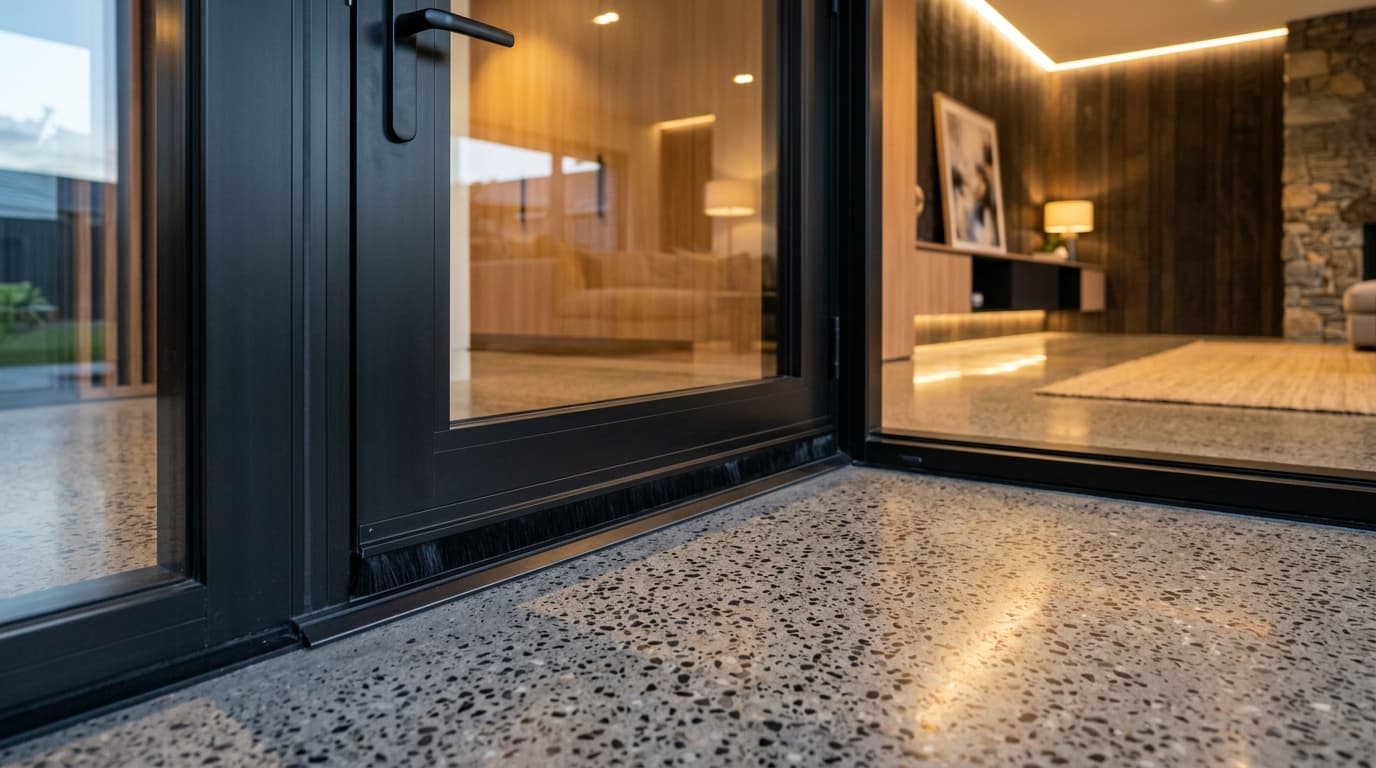
The gap under the door is the biggest opening in most rooms. Which seal suits which door, and why brush beats rubber on a door that opens all day.
How do I stop dust coming into a room under the door?
Fit a bottom seal. The gap under a door is typically 8 to 12 mm across the full width, which is a larger opening than every other gap in the room combined, and it is where most dust arrives.
Find the gap before you buy anything
Close the door and turn the lights off in the room, leaving them on outside. The gaps show up as light.
In almost every case the line under the door is the widest and longest of them. A 10 mm gap across a 900 mm door is 9,000 square millimetres of permanent opening — larger than the gaps around the whole rest of the frame put together.
That is where the dust is coming from, and it is the cheapest one to close.
Brush or rubber
A brush seal uses dense nylon bristles in an aluminium or PVC carrier. The bristles sweep across the floor as the door moves, and because they flex they tolerate an uneven floor and a gap that varies across the width.
A rubber wiper seals more completely against a flat, even floor, but it drags. On a door that is opened dozens of times a day the rubber wears at the contact edge and eventually tears.
For a door in constant use — a shop, an office, a main entrance — fit brush. For a door that is mostly closed and needs the tightest possible seal, rubber does better.
Our SA-24 combines an aluminium carrier with a brush or rubber insert; SA-25 is a flexible PVC strip for lighter internal and glass doors.
Measure the gap, not the door
Cut length comes from the door width, but the seal type comes from the gap height, and the gap is rarely consistent.
Measure it at both ends and in the middle. Floors settle and thresholds are rarely dead level, and a seal chosen for the narrowest point will not reach the floor at the widest.
Where the gap varies by more than a couple of millimetres, brush handles it and a rigid wiper will not.
Do not forget the sides and top
Once the bottom is sealed, the remaining gaps become the largest. On a road-facing room or somewhere genuinely dusty, seal the perimeter too — a strip seal in the rebate around the frame closes the vertical gaps.
The same fitting also cuts noise noticeably. Most people buy a door seal for dust and are surprised by how much quieter the room becomes, which is worth knowing if you are on a highway-side property in Rajnandgaon or along the Ring Road in Raipur.
The gap behind the frame
There is one more gap, and it is invisible: the space between the door frame and the rough masonry opening. On a poorly finished installation that cavity connects the room to the wall void and, eventually, to outside.
PU foam fills it. That is the one job PU foam does well, and no strip seal can reach it. Foam degrades in sunlight, so it must be covered by the architrave or trim once cured.
Fitting
Most bottom seals cut to length with a hacksaw and screw to the face of the door. Cut a millimetre short rather than a millimetre long — a seal jammed against the frame at one end will bow.
Set the height so the brush or wiper just touches the floor with the door closed. Set it too low and the door becomes heavy to open and the seal wears out quickly. Too high and you have spent money on a decorative strip.
Check the door still swings freely over any threshold, floor mat or tile transition before you drive the final screws.
Have Questions About Profile Specifications for Your Project?
Speak directly with our metallurgical sales team. We assist architects and structural contractors with die design, alloy selection, and wind load calculations.
Written by Abhishek, Salasar Aluminium & Hardware
Technical Hardware & Aluminium Engineering Team at Salasar Aluminium & Hardware, Raipur. Expert guidance on door kits, closers, shower hinges, and architectural fittings.
Read Next

Aluminium Door Handle Types Explained: D, H, American and Taiwan
Four handle profiles, what each suits, and how to get the fixing centres right so you are not drilling a second set of holes.
Why Your Aluminium Window Rattles, and How to Fix It
Four causes, each with a different fix. How to work out which one you have before buying anything.