Aluminium Door Handle Types Explained: D, H, American and Taiwan

Four handle profiles, what each suits, and how to get the fixing centres right so you are not drilling a second set of holes.
Which door handle type should I choose?
Match the handle to the door size and how it opens. D-handles suit ordinary doors and cabinet shutters; H-handles are back-to-back pulls for large glass and timber entrances; American and Taiwan handles are contoured pull handles for entrance doors and sliding sashes.
Start with how the door opens
A sliding door needs a handle that does not project far, because anything that sticks out will foul the adjacent panel as it passes. A hinged door has no such constraint and can take a substantial pull.
That single question eliminates half the options before you start comparing shapes.
D-handles
A D-handle is the familiar squared-off U, fixed at both ends with the bar standing off the face of the door. Ours come in 5 inch and 6 inch.
This is the general-purpose choice: ordinary internal and external doors, cabinet and wardrobe shutters. It is comfortable for a full-hand grip, simple to fit, and there is nothing to go wrong.
H-handles
An H-handle is a back-to-back pull — matching bars on both faces of the door, bolted through. Ours run 12, 14, 18 and 24 inches.
The back-to-back arrangement is the point. On a heavy glass or solid timber entrance door the load goes through the door rather than into surface fixings, which is what lets it take the force of a heavy leaf being pulled repeatedly.
Scale the length to the door. A 24 inch handle on a standard domestic door looks out of proportion; a 12 inch one on a tall commercial entrance looks lost and gives less leverage than the door needs.
American and Taiwan handles
Both are contoured pull handles in 6 inch and 8 inch, and the difference is the profile.
The American handle has a fuller ergonomic section for a firm grip, which suits an entrance door someone pulls hard.
The Taiwan handle has a sleeker, lower-projection profile. That lower projection is what makes it the usual choice for sliding sashes, where clearance past the adjacent panel matters.
Handle locks
A handle lock combines the lever and a mortise cylinder in one fitting, so the door latches and locks from the handle itself rather than needing a separate lock body.
For a main door where you want one fitting to do both jobs, this is the tidier answer. It also means one set of holes rather than two.
Fixing centres matter more than the length
The single most common handle mistake is ordering by overall length and discovering the fixing centres do not match the holes already in the door.
The fixing centre is the distance between the bolt holes, and it is not a fixed proportion of the handle's length — two handles of the same nominal size from different patterns can differ.
If you are replacing a handle on a door that is already drilled, measure centre to centre between the existing holes and tell us that figure. If you are drilling fresh, choose the handle first and take the centres from it.
For glass doors, this is not a preference but a hard constraint: toughened glass cannot be drilled after tempering, so the holes are made when the glass is manufactured and the handle must match them exactly.
Finish
Handles are touched more than any other fitting in a building, and that is where a plated finish wears through first — you will see it as a bright patch exactly where hands land.
On a high-traffic door, particularly in a shop or an office, stainless holds its appearance far longer than a plated finish. In a dry domestic interior, plated is perfectly reasonable.
Match the finish across a whole property before ordering. Mixing matt black and CP chrome across one home is a common regret, and it is easily avoided by buying a door kit where handle, latch and stopper arrive matched.
Have Questions About Profile Specifications for Your Project?
Speak directly with our metallurgical sales team. We assist architects and structural contractors with die design, alloy selection, and wind load calculations.
Written by Abhishek, Salasar Aluminium & Hardware
Technical Hardware & Aluminium Engineering Team at Salasar Aluminium & Hardware, Raipur. Expert guidance on door kits, closers, shower hinges, and architectural fittings.
Read Next
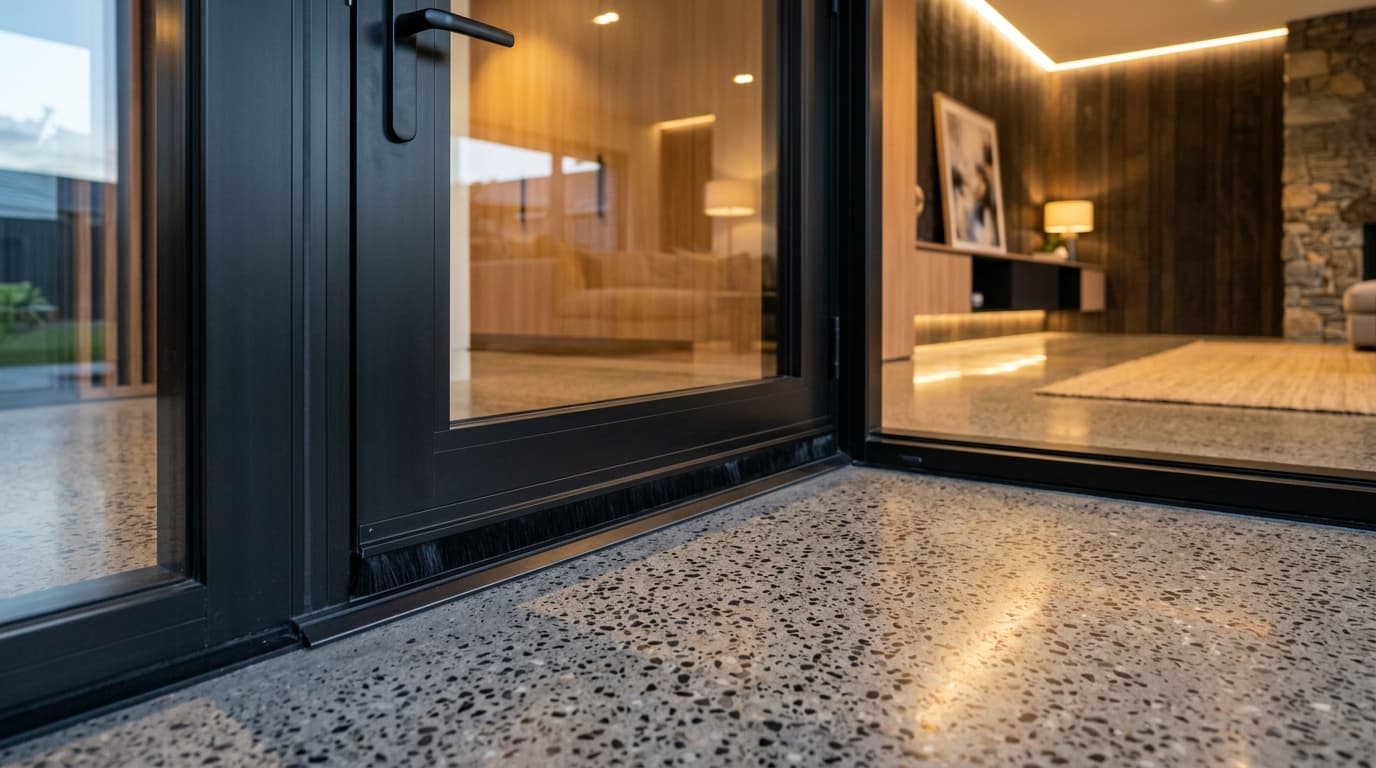
How to Stop Dust Coming Under a Door
The gap under the door is the biggest opening in most rooms. Which seal suits which door, and why brush beats rubber on a door that opens all day.
Why Your Aluminium Window Rattles, and How to Fix It
Four causes, each with a different fix. How to work out which one you have before buying anything.