Friction Stay Hinges vs Butt Hinges for Casement Windows: Selection & Load Guide
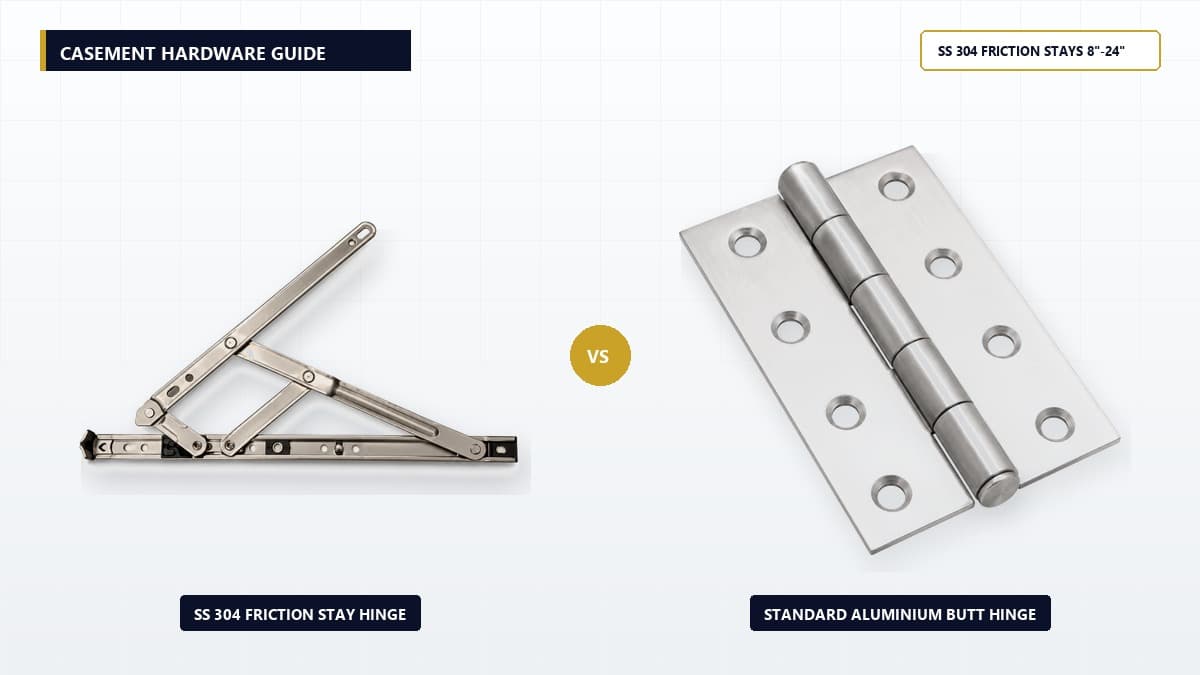
Choosing between concealed stainless steel friction stay hinges and traditional aluminium butt hinges for casement windows. Weight calculations, stack height (13mm vs 17mm), and wind resistance.
What is the main advantage of friction stay hinges over butt hinges on casement windows?
Friction stays hold the window sash open at any chosen angle (from 15° to 85°) without requiring a separate window peg stay or sill restrictor hook. Their internal friction slider resists gusty winds and prevents sudden slamming.
Can butt hinges hold a casement window open in windy weather?
No. Butt hinges swing freely on a fixed pivot pin. Without a manual casement stay or friction arm screwed to the sill, sudden wind gusts will slam the window shut or blow it violently open, risking glass shatter.
How do I choose between 13mm and 17mm stack height on friction stays?
Stack height is the depth cavity between the outer aluminium frame rebate and the sash extrusion channel. 13mm is the standard Indian architectural standard for Euro-groove and Domal profiles, while 17mm is used on deep commercial profiles and UPVC window systems.
How do I calculate casement window sash weight for hinge sizing?
Multiply glass area (height in metres x width in metres) by glass thickness (mm) x 2.5 kg/m² per mm of glass, then add 3 to 5 kg for the aluminium frame profile. For example, a 1.2m x 0.6m window with 5mm toughened glass weighs approximately 13 kg, easily handled by a standard 12-inch or 16-inch friction stay.
Why is SS 304 specified for casement friction stays instead of zinc-plated steel?
Friction stays sit exposed to exterior rainwater, condensation, and humidity inside the perimeter rebate. In Chhattisgarh monsoon season, zinc-plated steel pivots rust and bind, shearing the pivot rivets. Grade 304 stainless steel remains corrosion-free and maintains smooth adjustable tension for decades.
Two different philosophies of casement window operation
When designing an outward-opening aluminium casement window, fabricators face a fundamental architectural choice: hang the sash on external butt hinges, or fit concealed stainless steel friction stay hinges inside the perimeter groove.
Both carry the weight of the sash. But how the window behaves once you open it into the breeze is completely different.
Butt hinges leave the sash swinging freely like an internal door, demanding a secondary sill hook or casement peg stay to keep it open. Friction stays tuck completely into the perimeter rebate, holding the window firmly at whatever opening angle you leave it, with no visible hardware on the outside.
Here is how to calculate loads, select stay lengths, and choose the right mechanism for your architectural window schedule.
How a friction stay hinge works
A friction stay consists of four or five linked stainless steel arms connecting the outer frame track to the sash bar.
As the window pushes open, the arms scissors outward, moving the pivot point along the frame channel. Inside the track channel sits an adjustable brass or nylon friction slider. By turning the adjusting screw on the slider shoe, the fabricator tunes the resistance.
This friction holds the sash stationary against moderate wind forces without needing peg stays, casement hooks, or sill brackets. Furthermore, as the window swings open, the hinge-side stile pulls away from the frame by 80 to 100 mm, leaving a gap wide enough for an occupant to clean the exterior glass face from safely inside the room.
Where traditional butt hinges still make sense
Standard aluminium or stainless steel butt hinges pivot around a single fixed axis.
Their strengths are simplicity, extreme weight capacity, and wide opening angles. A heavy pair of extruded aluminium butt hinges (or 2D/3D adjustable hinges) can easily support an oversized sash weighing 60 to 80 kg, swinging fully 90° or 180° flat against the wall.
However, butt hinges do not hold an open position on their own. If an occupant pushes the window open on the fourth floor of an apartment during a Chhattisgarh pre-monsoon thunderstorm, a sudden cross-draft will slam the shutter shut or violently whip it backward, bending the frame or shattering the glass unless a manual stay hook is securely latched.
Top-hung vs side-hung friction stay geometry
Friction stays come in two distinct geometric configurations that must never be mixed up:
Top-hung stays (for awning windows): The friction stays are installed on the two vertical side jambs. The sash hinges outward from the top edge, swinging upward like a visor. Because gravity acts downward along the length of both stays simultaneously, top-hung stays carry heavier glass weights (typically 20 kg to 55 kg) and open to approximately 30° to 50°.
Side-hung stays (for casement windows): One friction stay is fitted along the top horizontal frame head, and the other along the bottom sill. The sash swings outward sideways like a door. Because the entire dead load of the glass hangs as a cantilever off the bottom track shoe, side-hung stays must be sized strictly to the sash width and carry lighter maximum loads (typically 18 kg to 35 kg).
Calculating sash load and selecting stay length
Never guess the length of a friction stay. A stay that is too short will twist under wind load, while an oversized stay will restrict the opening angle.
Step 1: Calculate the glass weight Glass has a universal density of 2.5 kg per square metre per millimetre of thickness. - Width (m) x Height (m) x Glass Thickness (mm) x 2.5 = Glass Weight in kg. - Example: A 1.2 m high x 0.6 m wide window with 5 mm toughened glass = 1.2 x 0.6 x 5 x 2.5 = 9.0 kg.
Step 2: Add the aluminium profile weight A standard aluminium casement sash frame (including corner cleats, glazing beads, and gasket) adds 3 to 5 kg. Total sash weight = ~13 kg.
Step 3: Select stay length based on sash dimension - For side-hung casement windows: The friction stay length should cover between 60% and 80% of the sash width. For a 600 mm (24-inch) wide sash, install a 16-inch (400 mm) side-hung stay. - For top-hung awning windows: The friction stay length should cover between 75% and 90% of the sash height. For a 900 mm (36-inch) high awning sash, install an 18-inch or 20-inch top-hung stay.
Stack height: 13 mm vs 17 mm clearance
Before ordering friction stays in bulk, measure the depth of the clearance cavity between the outer aluminium frame rebate and the sash extrusion.
13 mm stack height: The standard Indian and Euro-groove architectural standard for aluminium casement profiles (including Domal and standard 40mm casement suites). The folded stay arms collapse into a 13 mm thickness.
17 mm stack height: Designed for deep-rebate commercial aluminium systems, curtain wall vents, and UPVC profiles where the air gap is wider.
Installing a 17 mm stay into a 13 mm profile cavity will bind the sash before it closes, while fitting a 13 mm stay into a 17 mm cavity leaves a 4 mm gap, preventing the perimeter rubber weatherseal from compressing.
Stainless steel 304 vs plated steel in Chhattisgarh climate
Friction stays live in the perimeter rebate—the exact zone where exterior rainwater drains and condensation collects before venting out through weep holes.
Zinc-plated or MS friction stays rust within one or two rainy seasons. Once rust pits the sliding track or binds the brass slider, the homeowner must force the window shut, which shears the pivot rivets.
At Salasar Hardware, we exclusively supply Grade 304 (18/8 austenitic) stainless steel friction stays. SS 304 withstands high humidity, monsoon rain, and industrial airborne pollutants without pitting, ensuring the multi-link arms glide smoothly for tens of thousands of cycles.
Fabricator specification checklist
When placing your order for a casement window project in Raipur or across Chhattisgarh, have four numbers ready: 1. Window type: Side-hung casement (opens sideways) or top-hung awning (pushes out from bottom). 2. Sash width and height in millimetres. 3. Glass thickness (5mm, 6mm, or double glazed unit). 4. Stack height cavity (13mm standard or 17mm deep).
We stock heavy-duty SS 304 friction stays in 8", 10", 12", 14", 16", 20", and 24" lengths, complete with stainless steel mounting screws and adjustable tension shoes, ready for same-day workshop pickup in Raipur or bulk carton dispatch.
Need Help Selecting or Sourcing Hardware for Your Project?
Speak directly with Abhishek at our Bhaisthan counter. We stock all 86 standard hardware SKUs: sliding window rollers, door kits, door closers, and shower glass fittings at trade and retail rates.
Shop No. 3, JK Steel Gali, Bhaisthan, Raipur. No minimum order at counter.
Written by Abhishek, Salasar Aluminium & Hardware
Technical Hardware & Aluminium Engineering Team at Salasar Aluminium & Hardware, Raipur. Expert guidance on door kits, closers, shower hinges, and architectural fittings.
Read Next
How to Stop Dust Coming Under a Door
The gap under the door is the biggest opening in most rooms. Which seal suits which door, and why brush beats rubber on a door that opens all day.
Aluminium Door Handle Types Explained: D, H, American and Taiwan
Four handle profiles, what each suits, and how to get the fixing centres right so you are not drilling a second set of holes.